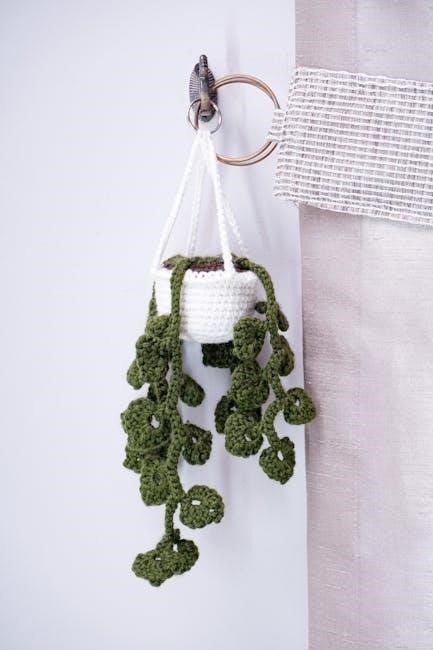
Crochet plant hangers are a stylish and affordable way to display your favorite greenery! Numerous free crochet hanging plant pattern PDFs are readily available online.
These patterns offer a delightful blend of texture and bohemian charm, enhancing any indoor or outdoor space with handmade artistry.
What are Crochet Plant Hangers?
Crochet plant hangers are decorative accessories crafted using the art of crochet, designed to suspend potted plants. They typically consist of a network of crocheted cords or loops that cradle the pot, allowing it to hang securely.
Many free crochet hanging plant pattern PDFs showcase diverse designs, from simple, minimalist styles to intricate, bohemian creations. These hangers add a touch of handmade charm and elevate the aesthetic of any indoor or outdoor space, offering a unique way to display plants.
They’re a fantastic DIY project!
Why Choose a Crochet Plant Hanger?
Choosing a crochet plant hanger offers a unique blend of style, affordability, and personalization. With countless free crochet hanging plant pattern PDFs available, you can create a hanger perfectly suited to your taste and décor.
They’re a cost-effective alternative to store-bought options and allow for creative expression through color and stitch choices. Beyond aesthetics, they maximize space, adding a touch of bohemian warmth and showcasing your plants beautifully.
It’s a rewarding craft!
Benefits of Using Free PDF Patterns
Free PDF crochet plant hanger patterns provide instant access to creative projects, saving money and offering a diverse range of designs for all skill levels.
Cost-Effectiveness
Free crochet plant hanger patterns, often available as PDF downloads, eliminate the expense of purchasing a pattern, making this a remarkably budget-friendly hobby.
You only need to invest in yarn and basic crochet tools, significantly lowering the overall project cost. This accessibility allows crafters of all financial backgrounds to enjoy the rewarding experience of creating beautiful, handmade home décor.
Exploring free patterns opens up a world of design possibilities without straining your wallet!
Accessibility and Convenience
Free crochet plant hanger patterns in PDF format are instantly downloadable, offering unparalleled convenience. Crafters can access patterns anytime, anywhere, with an internet connection.
This eliminates the need to visit a yarn store or wait for mail delivery, allowing for spontaneous crafting sessions.
The digital format also allows for easy printing or viewing on tablets and phones, making the pattern readily available during the crochet process – truly accessible crafting!
Wide Variety of Designs
The internet boasts a stunning wide variety of designs for free crochet plant hanger patterns in PDF format. From intricate boho macrame-inspired styles to simple, modern geometric patterns, there’s something for every skill level and aesthetic.
You’ll find options like the Chevron Hanging Planter and the Twisted Plant Pot Cover, alongside classic designs, ensuring a perfect match for your plants and home décor.
Popular Free Crochet Plant Hanger Patterns
Explore beloved free crochet plant hanger patterns like the Boho design by Alex DellAringa, Chevron by Hello Happy, and the Red Heart creation – easily found as PDFs!
Boho Plant Hanger by Alex DellAringa
Alex DellAringa’s Boho Plant Hanger is a widely popular free crochet pattern, readily available as a PDF download. This design features an open, diamond-like mesh created using simple crochet stitches and chains.
It’s considered a small hanging planter, perfect for showcasing smaller plants or succulents. The pattern is beginner-friendly, making it an excellent project for those new to crochet. Many crafters praise its quick completion time and the beautiful, textured aesthetic it brings to any home décor.
You can easily find the free PDF on Ravelry and other crochet resource websites.
Chevron Hanging Planter by Hello Happy
The Chevron Hanging Planter by Hello Happy is a vibrant and eye-catching free crochet pattern, easily accessible as a PDF. This design utilizes the classic chevron stitch to create a visually appealing, zig-zag pattern throughout the hanger.
It’s a fantastic way to add a pop of color and texture to your plant display. The pattern is suitable for intermediate crocheters, offering a slightly more challenging but rewarding project. Crafters appreciate its modern aesthetic and the ability to customize the colors to match their décor.
Find the free PDF on Hello Happy’s website!
Twisted Plant Pot Cover by Veronika
Veronika’s Twisted Plant Pot Cover is a unique and charming free crochet pattern available as a PDF download. This design features a beautiful twisted stitch detail that adds texture and visual interest to a simple plant pot.
It’s a relatively quick project, perfect for beginner to intermediate crocheters looking to experiment with new stitch techniques. The pattern allows for customization in terms of color and pot size, making it versatile for various plants and home décor styles.
Download the free PDF from Veronika’s online resources!
Red Heart Crochet Plant Hanger
The Red Heart Crochet Plant Hanger is a readily accessible free crochet pattern, offered as a PDF download through Yarnspirations. This pattern utilizes Red Heart yarn, known for its durability and vibrant color options, making it ideal for creating a long-lasting plant display.
The design is beginner-friendly, employing basic crochet stitches to construct a classic and functional plant hanger. It’s a fantastic project for those new to crochet or seeking a quick and satisfying make. Find the free PDF on the Yarnspirations website!
Eryn Plant Hanger Free Crochet Pattern
The Eryn Plant Hanger is a popular free crochet pattern, perfect for quickly adding a touch of handmade charm to your home décor. Available as a PDF download, this pattern is celebrated for its simplicity and suitability for both beginner and experienced crocheters.
It’s an excellent project for showcasing indoor or outdoor plants, and the pattern works up quickly with readily available materials. The free PDF provides clear instructions, making it an enjoyable and rewarding crochet experience!
Essential Materials for Crochet Plant Hangers
Crochet plant hangers typically require yarn (cotton, jute, or acrylic), a crochet hook, scissors, and a yarn needle – easily sourced for free PDF projects!
Yarn Types (Cotton, Jute, Acrylic)
Choosing the right yarn is crucial for your free crochet plant hanger. Cotton yarn is a popular choice due to its strength, durability, and ability to hold the weight of a potted plant beautifully.
Jute yarn offers a rustic, natural look, perfect for a bohemian aesthetic, though it can be less soft to work with.
Acrylic yarn is a budget-friendly option, available in a wide range of colors, but may not have the same structural integrity as cotton or jute. Consider the plant’s weight and desired style when selecting your yarn for free PDF patterns.
Crochet Hook Sizes
Selecting the appropriate crochet hook size is vital when working with free crochet plant hanger patterns. Generally, a 5mm (H/8) or 6mm (J/10) hook works well with medium-weight cotton yarn, commonly used in these projects.
However, always check the specific free PDF pattern for the recommended hook size, as it can vary.
Using the correct hook ensures proper stitch definition and the hanger’s structural integrity to safely support your plants. Adjust hook size if needed to achieve the desired gauge.
Other Necessary Tools (Scissors, Yarn Needle)
Beyond yarn and a crochet hook, a few essential tools will streamline your free crochet plant hanger project. Sharp scissors are crucial for cleanly cutting yarn ends. A yarn needle, also known as a tapestry needle, is indispensable for weaving in those loose ends securely.
These finishing touches ensure a polished look and prevent unraveling.
Consider stitch markers to help keep track of rounds, especially when following a free PDF pattern, and a measuring tape to verify your gauge.
Basic Crochet Stitches Used
Free crochet plant hanger patterns commonly utilize fundamental stitches like the chain (ch), single crochet (sc), double crochet (dc), and slip stitch (sl st).
Chain Stitch (ch)
The chain stitch is the very foundation of most free crochet plant hanger patterns, serving as the starting point for numerous projects. It’s denoted as “ch” in PDF instructions and creates a series of interconnected loops.
Mastering the chain stitch is crucial, as it establishes the initial ring or length needed for the hanger’s structure. Many patterns begin with creating a magic ring using chain stitches, providing a seamless base. Consistent chain tension is key for achieving an even and aesthetically pleasing final product.
Single Crochet (sc)
Single crochet (sc) is a fundamental stitch frequently used in free crochet plant hanger patterns, often indicated as “sc” in PDF guides. It’s a tight, dense stitch that provides excellent structure and durability to the hanger.
This stitch is commonly employed to build up the body of the hanger and create the supportive netting for the plant pot. Achieving consistent single crochet stitches ensures a uniform texture and prevents gaps, contributing to a polished and professional finish.
Double Crochet (dc)
Double crochet (dc), often abbreviated as “dc” in free crochet plant hanger pattern PDFs, is another essential stitch. It’s taller than single crochet, creating a more open and airy fabric, ideal for decorative elements within the hanger’s design.
Many patterns utilize double crochet to form the initial ring or to create the longer chains that define the hanger’s overall length and aesthetic. Mastering this stitch allows for greater design flexibility and a beautiful drape.
Slip Stitch (sl st)
The slip stitch (sl st), frequently denoted as “sl st” in free crochet plant hanger pattern PDFs, is a foundational stitch for joining rounds or finishing off edges. It creates a nearly invisible seam, ensuring a clean and polished look for your handmade plant hanger.
Often used to secure the beginning and end of rows, or to join pieces together, the slip stitch provides a subtle yet crucial element in constructing a durable and aesthetically pleasing hanger.
Understanding Crochet Plant Hanger Patterns (PDF Format)
Free crochet plant hanger pattern PDFs utilize charts, abbreviations, and gauge information for successful projects. Familiarity with these elements ensures accurate results!
Reading Crochet Charts
Crochet charts, often found within free crochet hanging plant pattern PDFs, visually represent stitch patterns. Instead of written instructions, they use symbols to depict each stitch – a square for single crochet, a taller rectangle for double crochet, and so on.
Understanding these symbols is key. Charts are read in rows, typically from right to left for odd rows and left to right for even rows. They eliminate language barriers and offer a quick overview of the design. Learning to decipher these visual guides unlocks a world of intricate plant hanger designs!
Abbreviations and Symbols
Free crochet hanging plant pattern PDFs consistently utilize a standardized set of abbreviations and symbols. Common abbreviations include ‘ch’ for chain, ‘sc’ for single crochet, ‘dc’ for double crochet, and ‘sl st’ for slip stitch.
Symbols visually represent these stitches within charts. Familiarizing yourself with this “crochet shorthand” is crucial for successful pattern following. A key or legend is always included in the PDF, defining each abbreviation and symbol used, ensuring clarity and preventing errors during your project.
Gauge and Sizing
Free crochet hanging plant pattern PDFs often include gauge information, typically expressed as stitches and rows per inch or centimeter. Checking your gauge—creating a small swatch—ensures your finished hanger will be the intended size.
Sizing is crucial, as it dictates whether your pot will fit correctly. Patterns may offer multiple sizes; always verify your tension matches the pattern’s gauge before proceeding. Adjust hook size if needed to achieve accurate dimensions.
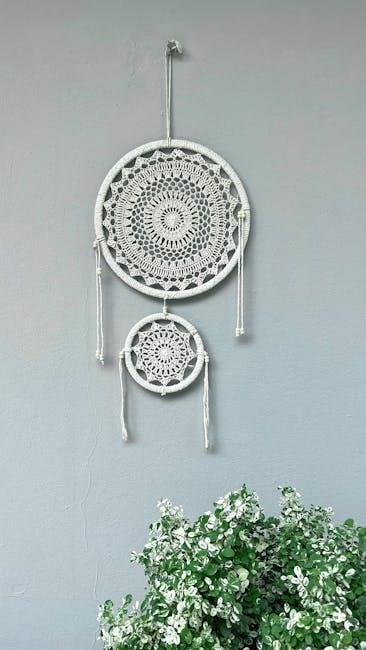
Step-by-Step Guide to Making a Simple Crochet Plant Hanger
Free crochet hanging plant pattern PDFs typically begin with creating a magic ring, followed by working the body with basic stitches and loops.
Creating the Initial Ring
Free crochet hanging plant pattern PDFs almost universally start with forming a magic ring, also known as a magic circle. This technique allows you to begin crocheting in the round without leaving a noticeable hole in the center.
To create it, wrap the yarn around your fingers, insert the hook, pull up a loop, and chain one to secure. Work the initial stitches – often single or double crochet – directly into the ring.
Pull the yarn tail tightly to close the ring completely, forming a solid base for your plant hanger’s construction.
Working the Body of the Hanger
Free crochet hanging plant pattern PDFs typically build the body of the hanger using repeating rows of basic stitches like chain, single crochet, or double crochet. Many patterns utilize variations to create decorative elements, such as V-stitches or twisted sections.
Increasing stitches in each round is common, gradually widening the hanger to accommodate the plant pot.
Pay close attention to stitch counts and pattern instructions to maintain the desired shape and prevent unwanted gaps or distortions.
Forming the Plant Pot Holder
Free crochet hanging plant pattern PDFs often create the pot holder by continuing the increases from the body, forming a snug “basket” to securely hold the plant.
This section frequently involves decreasing stitches in subsequent rounds to gently taper the hanger, ensuring a stable base for the pot.
Carefully check the pattern’s gauge to guarantee a proper fit; a too-tight or too-loose holder won’t function effectively.
Adding Hanging Loops
Free crochet hanging plant pattern PDFs typically conclude with creating sturdy hanging loops. These are commonly formed using chain stitches, attached securely to the main body of the hanger.
The number and length of loops vary depending on the desired aesthetic and weight distribution.
Reinforcing the attachment points with a slip stitch or two ensures durability, preventing the loops from unraveling under the pot’s weight.
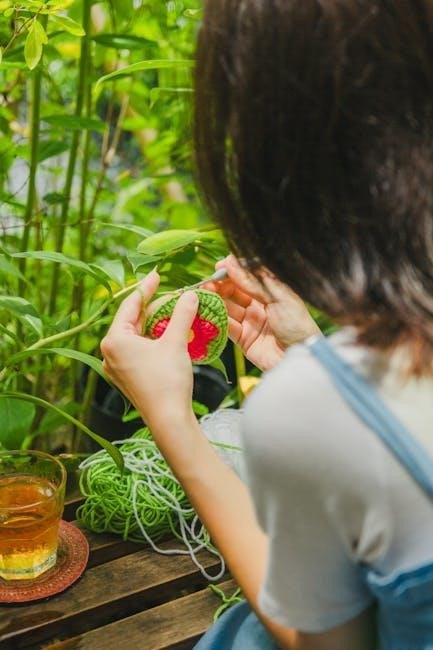
Customization Options
Free crochet hanging plant pattern PDFs are easily personalized! Experiment with vibrant color combinations, playful beads, or charming tassels to reflect your style.
Color Combinations
Free crochet hanging plant pattern PDFs offer fantastic opportunities for creative expression through color. Consider earthy tones like greens and browns for a natural aesthetic, or embrace bold, vibrant hues for a statement piece.
Ombre effects, achieved by gradually transitioning between shades, add a modern touch. Mixing complementary colors—like blue and orange—creates visual interest. Don’t be afraid to experiment with variegated yarns for a unique, multi-toned look!
The possibilities are endless, allowing you to perfectly match your crochet plant hanger to your home décor and personal preferences.
Adding Beads or Tassels
Enhance your crochet plant hanger, created from a free crochet hanging plant pattern PDF, with charming embellishments! Adding beads or tassels introduces texture and personality. Wooden beads offer a natural, bohemian vibe, while glass beads add a touch of elegance.
Tassels, easily made with yarn scraps, create movement and visual interest. Attach them to the bottom of the hanger or along the sides. Experiment with different bead sizes, colors, and tassel lengths to achieve your desired look!
Adjusting Size for Different Pots
When using a free crochet hanging plant pattern PDF, easily customize the size to fit various pots! To enlarge, increase the number of chains in the initial ring and rows in the body. For smaller pots, decrease these measurements accordingly.
Remember to maintain consistent stitch tension for a uniform look. Always test-fit the pot during construction to ensure a snug, secure hold. Adjusting the length of the hanging loops also impacts the overall size and display height.
Troubleshooting Common Issues
Free crochet hanging plant pattern PDFs can sometimes present challenges! Common issues include uneven stitches, incorrect sizing, or difficulty understanding the pattern instructions.
Uneven Stitch Tension
Uneven stitch tension is a frequent problem when working with free crochet hanging plant pattern PDFs, especially for beginners. This results in a wonky or misshapen hanger. To combat this, consciously maintain consistent yarn handling and hook pressure throughout your project.
Practice makes perfect! If you notice tension issues, don’t be afraid to frog (rip out) sections and redo them. Blocking the finished hanger can also help even out stitches, providing a more polished look.
Remember to relax your hands and avoid gripping the hook too tightly.
Incorrect Sizing
Incorrect sizing is a common issue when following free crochet hanging plant pattern PDFs. This often stems from differences in yarn weight or hook size used compared to the pattern’s recommendations. Always check your gauge – create a small swatch and compare it to the pattern’s specified measurements.
Adjust your hook size if needed to achieve the correct gauge. Remember that even slight variations can significantly impact the final size of your plant hanger.
Careful measurement is key!
Difficulty Reading the Pattern
Difficulty reading the pattern is frequent with free crochet hanging plant pattern PDFs, especially for beginners. Patterns utilize abbreviations and symbols that require understanding. Familiarize yourself with common crochet terms and symbols before starting.
Online resources and video tutorials can help decipher complex instructions.
If a chart is included, learn to interpret it. Don’t hesitate to search for clarification online or ask for help from the crochet community!

Where to Find More Free Patterns
Free crochet hanging plant pattern PDFs abound on platforms like Ravelry, Yarnspirations, and Pinterest, offering diverse designs and skill levels for enthusiasts.
Ravelry
Ravelry is an invaluable resource for free crochet hanging plant pattern PDFs, boasting a massive database contributed by designers worldwide. You can filter searches by yarn weight, hook size, and difficulty level to pinpoint the perfect project.
The platform allows you to view project photos from other crocheters, offering inspiration and insight into pattern clarity. Many patterns include detailed instructions and helpful charts, making them accessible for various skill levels. Creating a free account unlocks access to the full Ravelry experience, including pattern downloads and community forums.
Yarnspirations
Yarnspirations provides a fantastic collection of free crochet hanging plant pattern PDFs, particularly those utilizing their branded yarns like Red Heart. Their website features a dedicated section for home décor, including numerous plant hanger designs suitable for beginners and experienced crocheters alike.
Patterns are presented with clear instructions, stitch diagrams, and often include video tutorials. You’ll discover a variety of styles, from simple macramé-inspired designs to more intricate, textured creations. Downloading patterns from Yarnspirations is typically quick and easy, requiring minimal registration.
Pinterest serves as a visual discovery engine brimming with free crochet hanging plant pattern PDFs! A simple search reveals a vast array of links to blogs, Ravelry projects, and direct downloads. It’s an excellent platform for finding inspiration and exploring diverse styles, from boho chic to minimalist designs.
Users often share photos of completed projects, providing valuable insight and modifications. Be prepared to navigate through numerous pins, but the visual nature of Pinterest makes discovering your next crochet project incredibly enjoyable and efficient.
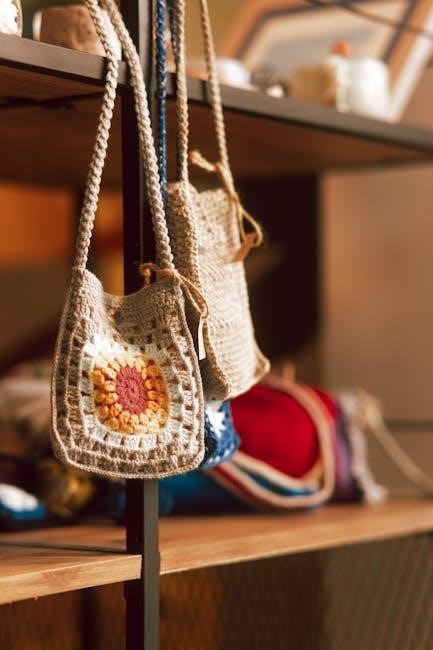
Caring for Your Crochet Plant Hanger
Crochet plant hangers are generally easy to care for; gentle hand washing is recommended to maintain their shape and beauty after use!
Washing Instructions
To clean your crochet plant hanger, hand washing is always the safest method. Use cool water and a mild detergent, gently squeezing the hanger to remove dirt. Avoid harsh chemicals or bleach, as these can damage the yarn fibers.
Rinse thoroughly until all soap residue is gone.
Do not wring the hanger, as this can distort its shape. Instead, gently roll it in a clean towel to absorb excess water.
Lay flat to dry, reshaping as needed. Avoid direct sunlight, which can fade the colors.
Storage Tips
When not in use, store your crochet plant hanger in a clean, dry place, away from direct sunlight and potential pests. Gently fold or loosely roll the hanger to prevent creasing or stretching.
Avoid storing it in airtight containers, as this can trap moisture and lead to mildew.
Consider hanging the hanger on a hook or hanger to maintain its shape.
If storing multiple hangers, separate them with tissue paper to prevent color transfer. Proper storage ensures your creation remains beautiful for years!
Safety Considerations
Always check the weight capacity of your hanger and ensure secure installation. Select a sturdy hanging location, avoiding areas with high traffic or potential damage.
Weight Limits
Determining safe weight limits is crucial when using free crochet hanging plant pattern PDFs. Crochet plant hangers, while beautiful, aren’t designed for extremely heavy pots.
Consider the yarn type; cotton and jute offer good strength, while acrylic may be less durable. The stitch density and construction also impact weight capacity. A small succulent pot is generally safe, but larger terracotta pots require caution.
Always err on the side of caution and test the hanger with a lighter object before entrusting it with your plant. Regularly inspect for wear and tear.
Hanging Location
Selecting a suitable hanging location is vital when utilizing free crochet hanging plant pattern PDFs. Avoid areas with high foot traffic to prevent accidental bumps and potential falls.
Ensure the chosen hook or mounting point is securely anchored to support the weight of the plant and hanger. Consider sunlight requirements for your plant when selecting a spot.
Protect surfaces below from potential water leakage and choose a location away from drafts or extreme temperatures.
No Responses